How Restaurant Owners Can Think About Online Ordering Costs
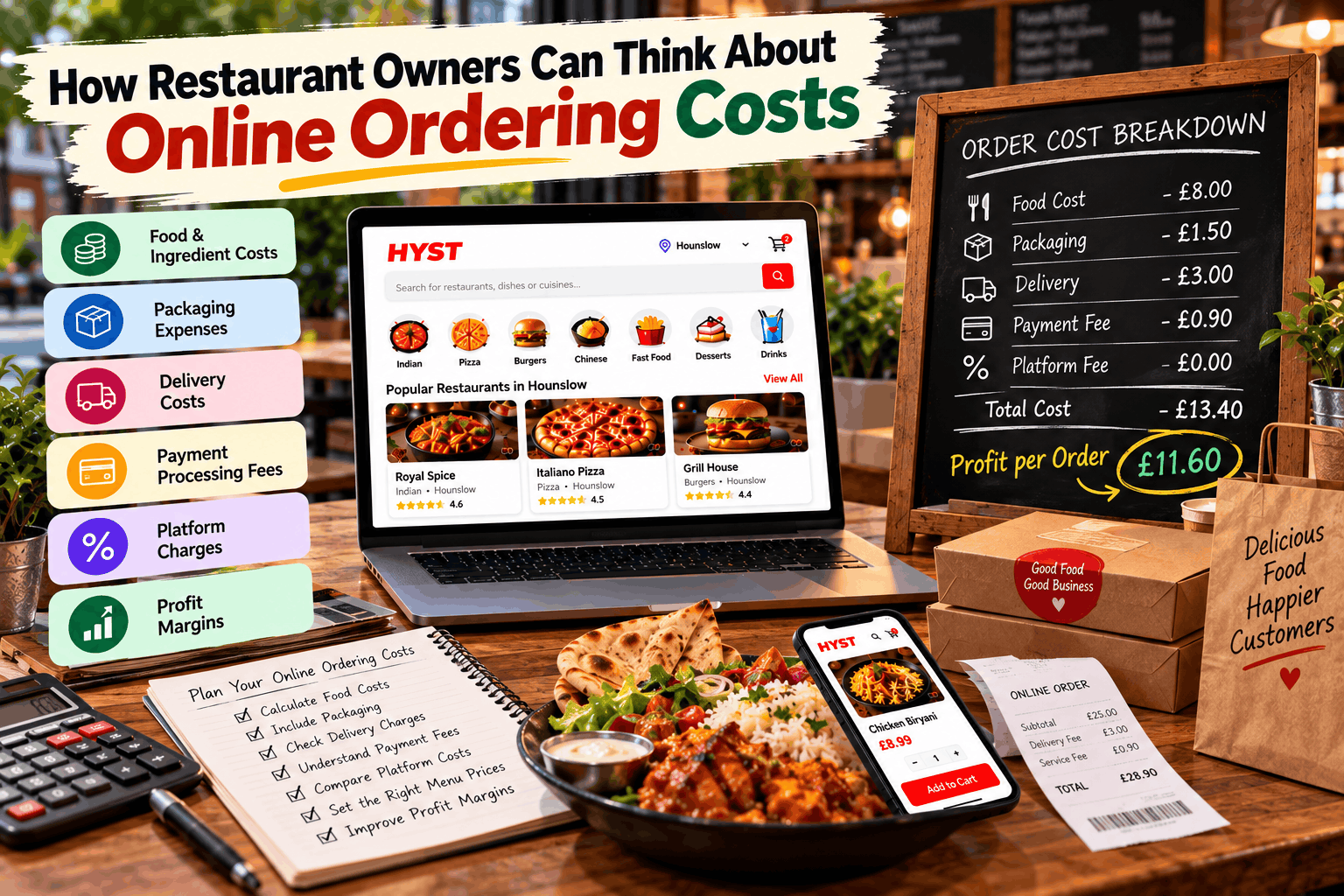
For independent restaurants, cafés and takeaways across the UK, understanding the cost of online ordering is an important part of building a sustainable food business. Platforms such as HYST provide another option for restaurants exploring online food ordering, digital menus and direct ordering models. Before choosing an ordering channel, restaurant owners should understand how commissions, payment processing, delivery, packaging and marketing affect the money retained from each order.
Online ordering can help restaurants reach customers who search for food online rather than visit a restaurant in person. However, more orders do not automatically mean higher profits. A restaurant might receive a large number of online orders while retaining less revenue than expected because of food costs, delivery expenses and platform-related charges.
For restaurants in Hounslow, London and across the UK, the key is to understand the complete cost of each order and select an ordering strategy that fits the business.
1. Why Online Ordering Costs Matter
Every restaurant has operating costs, whether customers dine in, collect takeaway food or order delivery.
Online ordering introduces additional considerations because a single transaction may involve several services and expenses.
Restaurant owners may need to account for:
- Food ingredients and preparation
- Takeaway packaging
- Staff time
- Online payment processing
- Delivery expenses
- Marketplace commission
- Advertising and promotions
- Ordering software
- Refunds and cancellations
- Customer support
The exact costs depend on the restaurant's operations and the commercial agreement associated with each ordering channel.
Understanding these expenses helps restaurant owners compare online restaurant ordering platforms based on actual business performance rather than the number of orders alone.
2. Understand the Cost of Every Online Order
The first step is to calculate the contribution from a typical order.
Consider a restaurant that receives a £30 online food order. The restaurant should identify its food cost, packaging expense, payment charges, delivery cost and any applicable platform fees.
A simplified calculation is:
Order revenue − variable costs associated with the order = contribution before other business expenses
For example, if the restaurant receives £30 and the combined variable costs are £18, the contribution is £12 before rent, utilities, fixed salaries, taxes and other overheads.
This is an illustrative example, not a prediction of actual restaurant profitability.
The calculation helps owners understand why revenue and profit are not the same thing.
3. Compare Commission-Based and Zero-Commission Models
Different online food ordering models can have different commercial structures.
Some marketplace agreements include a percentage-based commission, while other arrangements may use different fees or pricing structures.
HYST currently promotes a zero-commission model for participating restaurant partners. Its restaurant partner programme provides information about its current model and partner arrangements.
Restaurants should still review the full agreement, because zero commission does not necessarily mean that payment processing, delivery, packaging, marketing or every other service is free.
A fair comparison should consider the complete cost of fulfilling an order under each model.
4. Calculate the Effect of Commission on Restaurant Margins
Commission can make a difference to the amount retained from an order.
Suppose a restaurant receives a £25 order under an agreement that charges 20% commission. The marketplace commission would be £5, leaving £20 before food costs and other expenses.
Under a hypothetical zero-marketplace-commission arrangement, the full £25 would remain before other applicable costs.
The difference in this simplified example is £5 per order. Actual savings depend on the restaurant's contract, qualifying orders and any additional costs.
Restaurant owners should avoid comparing commission rates alone. The important measure is how much contribution remains after all relevant order-related expenses.
5. Do Not Forget Payment Processing Costs
Online payments are convenient for customers, but payment processing can be a separate cost for a restaurant.
Depending on the payment provider and agreement, charges may depend on the transaction value, payment method or other contractual conditions.
Owners should check:
- The applicable processing fee
- Any fixed transaction charge
- Settlement and payout arrangements
- Refund processing
- Chargeback procedures
- Any additional payment-related fees
These details should be confirmed directly from the relevant provider's current terms.
Payment processing is one reason why a restaurant should calculate the full cost of online food ordering instead of assuming that one advertised fee represents the entire cost.
6. Understand Delivery and Packaging Expenses
Delivery can be a significant part of online restaurant operations.
Some restaurants employ their own delivery staff, while others use third-party courier services or arrangements provided through an ordering platform.
Each approach has different operational and financial implications.
Restaurants should consider fuel, vehicle costs, courier charges, delivery coverage, packaging, food temperature and the time needed to prepare orders for collection or dispatch.
Packaging also matters. Food containers, bags, seals, cutlery and other materials can add up across a high volume of orders.
A restaurant should compare delivery options according to its location, average order value, cuisine and customer expectations.
7. Consider Marketing and Customer Acquisition
An online ordering platform may help customers discover a restaurant, but the value of that exposure depends on whether it generates suitable customers and profitable orders.
Restaurants may also spend money on search advertising, social media campaigns, photography, local promotions and website development.
These expenses should be measured against the results they generate.
For example, a restaurant can track how many customers visit its menu page, click the ordering link and complete an order. This helps owners understand which marketing activities are contributing to business performance.
For restaurants investing in direct online ordering, HYST's guide to increasing direct online orders offers additional context on improving the online customer journey.
8. Keep Menu Prices and Availability Accurate
Online menu management affects both customer experience and operating costs.
If a dish is listed at an outdated price, the restaurant may face a pricing dispute. If an unavailable dish remains on the menu, staff may need to contact the customer, arrange a substitution or issue a refund.
Restaurant owners should regularly review:
- Dish prices
- Portion sizes
- Add-ons and variants
- Food descriptions
- Product availability
- Opening hours
- Delivery information
- Collection options
- Allergen information
HYST's restaurant ordering FAQs describe menu, pricing and availability controls for participating restaurant partners.
Accurate digital menus can help reduce avoidable confusion and make restaurant operations easier to manage.
9. Measure the Value of Each Ordering Channel
Restaurant owners should compare ordering channels using actual results.
Useful measures may include:
- Total online sales
- Completed order volume
- Average order value
- Contribution per order
- Customer acquisition cost
- Repeat order rate
- Refund and cancellation rate
- Delivery expense per order
- Marketing spend
- Customer satisfaction
A channel with higher sales is not necessarily the most profitable if it also has significantly higher costs.
Likewise, a low-cost ordering channel may not provide enough customer reach to meet the restaurant's sales objectives.
The best decision comes from evaluating the complete business result.
10. Use Direct Ordering as Part of a Wider Strategy
Direct online ordering can be one part of a restaurant's digital strategy.
A restaurant might use its website, social media, local search presence and restaurant-specific ordering pages to help customers find its menu.
The business should also understand which customer information it can access, how that information can be used and which privacy requirements apply.
Restaurants should not assume that every ordering platform gives them the same customer data or marketing permissions.
For more context on the commercial side of online ordering, read HYST's guide to zero-commission food ordering.
11. Build a Simple Monthly Cost Review
A monthly review can help restaurant owners identify expenses that are increasing and channels that are performing well.
A practical review should include:
- Total orders received through each channel.
- Revenue generated by those orders.
- Food and packaging costs.
- Payment and delivery expenses.
- Platform fees and marketing expenditure.
- Contribution remaining after variable costs.
- Refunds, cancellations and recurring problems.
The restaurant can then decide whether to adjust menu pricing, change its delivery arrangements, improve marketing or review its ordering agreements.
This approach makes financial decisions more evidence-based.
Conclusion
Online ordering costs involve much more than marketplace commission. Restaurant owners need to consider food preparation, packaging, payments, delivery, marketing, software and the other expenses associated with fulfilling orders.
For independent restaurants in Hounslow and across the UK, understanding the complete cost structure can help identify which ordering channels best support their business objectives.
HYST is one option for restaurants evaluating a zero-commission model for participating partners, but each business should compare the actual commercial terms and operational requirements before deciding.
Restaurant owners can review the HYST terms and conditions alongside their individual agreement before making a decision.
Ultimately, the goal is not simply to receive more online orders. It is to create a convenient customer experience while maintaining a clear understanding of costs, margins and sustainable business performance.