Why Fair Menu Pricing Matters When Ordering Food Online
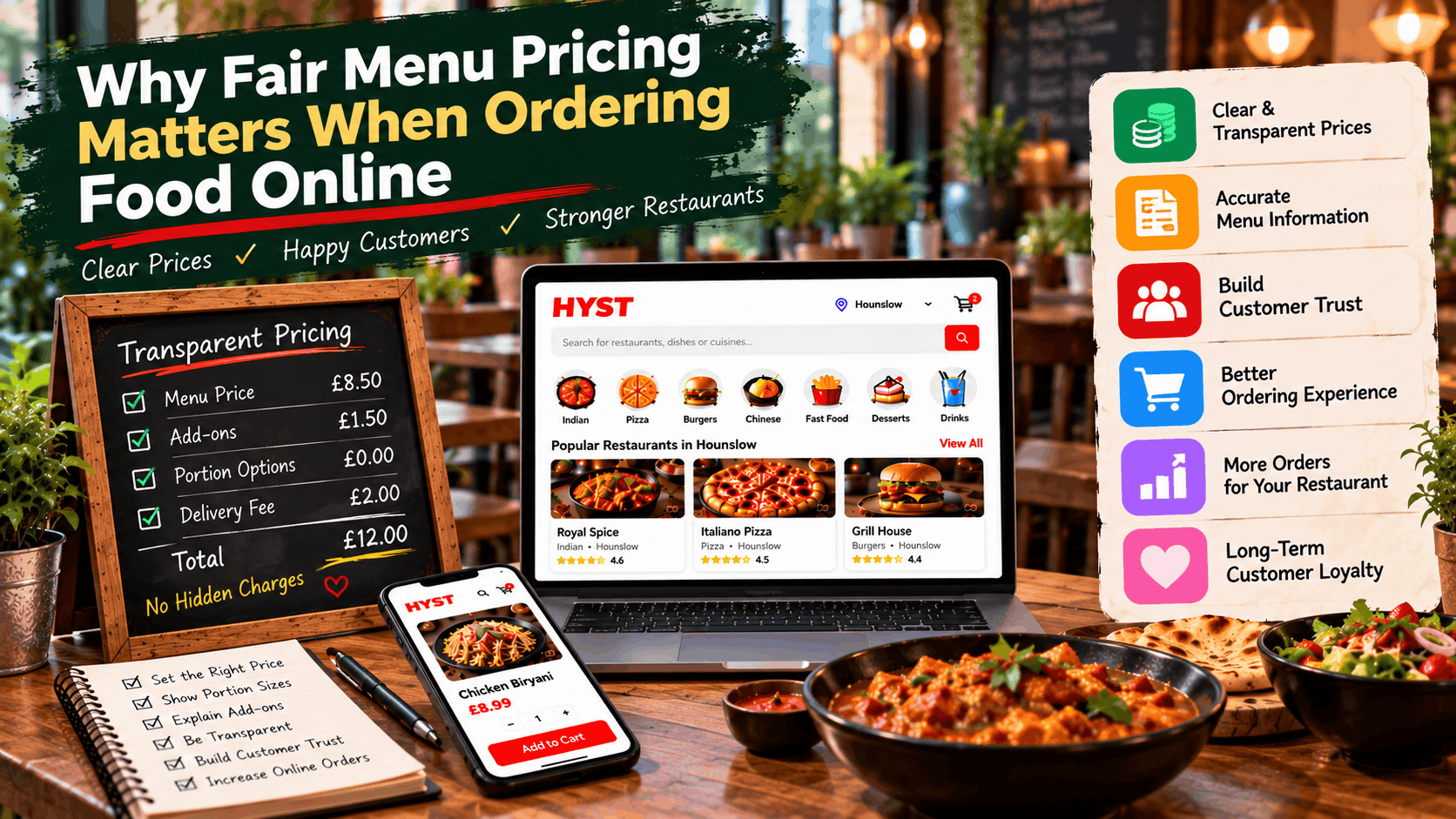
Fair and transparent menu pricing is an important part of a trustworthy online food ordering experience. Customers using platforms such as HYST want to browse restaurant menus, understand food prices and know what they are paying for before completing an order. For independent restaurants in Hounslow, London and across the UK, clear pricing can help reduce confusion, support customer confidence and create a more professional digital presence.
Online customers can often compare several restaurants within minutes. They may review different cuisines, portion sizes, delivery options and prices before deciding where to order. If a restaurant's pricing is unclear or its menu contains outdated information, customers may hesitate or choose another business.
Fair menu pricing does not mean every restaurant must offer the lowest price. It means presenting prices accurately, explaining additional costs and helping customers understand the value of the food they choose.
1. What Does Fair Menu Pricing Mean?
Fair menu pricing means that customers can understand what a dish costs and what is included in that price.
A clear online restaurant menu should provide accurate prices, useful descriptions and information about paid extras or available variations.
Customers should be able to identify:
- The price of each dish
- Portion or size options
- Optional extras
- Additional ingredient charges
- Meal combinations
- Delivery or collection details
- Applicable service or other charges
- The final order total
Restaurants should ensure that their online information reflects the prices and options currently available under their ordering arrangements.
Fair pricing is about transparency, not simply being cheap.
2. Why Customers Compare Prices Online
Online food ordering makes it easier for customers to compare restaurant menus.
Someone searching for restaurants near me may open several websites before making a decision. A customer looking for Indian takeaway in Hounslow may compare dishes, portion sizes and prices. Another person searching for pizza delivery in Hounslow may look at toppings, meal options and delivery information.
This makes online menu presentation an important part of the customer experience.
Useful search terms for relevant restaurant content include:
- Fair restaurant pricing
- Online menu prices
- Transparent food pricing
- Online food ordering UK
- Restaurants in Hounslow
- Hounslow takeaway
- Food delivery Hounslow
- Indian restaurants Hounslow
- Pizza delivery Hounslow
- Restaurant menu management
- Food delivery near me
- Order takeaway online
Restaurants should use these keywords only where they accurately describe the business and the page's subject.
3. Clear Prices Help Build Customer Trust
Trust matters when customers order food without visiting the restaurant first.
Customers rely on the menu, food descriptions, photographs and prices to decide whether the restaurant meets their expectations.
If the online menu displays one price but the customer encounters an unexplained difference later in the ordering process, the experience can feel confusing.
Restaurants should therefore keep prices consistent across relevant channels and explain any applicable additional costs clearly.
For more context, read HYST's guide to clear menu pricing for online food customers.
4. Avoid Unexpected Costs at Checkout
A customer may choose a main dish, side, drink and extra topping while building an online order.
If the additional charges are clearly displayed, the customer can understand the cost as they make selections.
Problems can arise when extra charges appear late in the checkout process or when the final total is difficult to understand.
A transparent checkout should show the selected items, quantities, item prices, applicable charges and final amount before payment.
Delivery and service charges should be explained accurately according to the relevant ordering arrangement.
This makes the process easier to understand and helps customers make informed decisions.
5. Fair Pricing Does Not Mean Being the Cheapest
Restaurants face different ingredient costs, staffing requirements, rent, energy expenses and operational challenges.
A restaurant using fresh ingredients or offering larger portions may have a different pricing structure from a business with a smaller menu or different operating model.
Customers need enough information to understand what they are receiving for the price.
Restaurants can communicate value through clear food descriptions, accurate portion information, good-quality photographs and consistent food preparation.
The objective is to make the menu easy to understand, not to compete solely on the lowest price.
6. Keep Online Menus Accurate
Restaurant menus change over time.
Ingredients become more expensive, seasonal items become unavailable and businesses introduce new dishes or portion options.
If the online menu is not updated, customers may see prices or options that the restaurant can no longer provide.
Restaurants should regularly review:
- Current dish prices
- Portion sizes
- Food descriptions
- Optional extras
- Product availability
- Meal deals
- Opening hours
- Delivery and collection information
- Dietary and allergen details
HYST's restaurant ordering FAQs explain how participating restaurant partners can manage their menu items, prices and availability.
Maintaining accurate information should be part of normal restaurant operations rather than an occasional task.
7. Use Digital Menu Management Effectively
Digital menus give restaurants a practical way to present current food information online.
A restaurant may need to change a price, add a dish, update an image or mark an item unavailable. The ability to make these changes efficiently can help keep the customer-facing menu accurate.
Restaurants should select digital tools that suit their operational needs and make routine updates manageable.
HYST's restaurant partner programme describes its current approach to restaurant menu and price control for participating partners.
The specific tools and commercial terms available should always be confirmed with the platform before joining.
8. Make Menu Pricing Easy to Understand on Mobile
Many customers browse restaurant menus on smartphones.
Prices should be readable, menu categories should be clear and important information should not be hidden behind complicated navigation.
A mobile-friendly online menu should allow customers to compare dishes, choose variations and review their basket without repeatedly zooming or navigating between unnecessary pages.
Restaurants should test their ordering experience on different screen sizes and check that prices remain visible throughout the journey.
A simple interface can help customers focus on their food choices rather than trying to understand the website.
9. Explain Add-Ons and Portion Options Clearly
Some dishes offer multiple sizes, additional ingredients or customisation options.
These choices should be described clearly so customers understand how their selections affect the price.
For example, a customer choosing a small or large meal should be able to identify the price of each option. An extra topping should display its applicable charge before the customer adds it.
The same principle applies to drinks, sides, sauces and meal combinations.
Clear descriptions reduce uncertainty and help customers complete their orders with realistic expectations.
10. Understand the Relationship Between Pricing and Restaurant Costs
Fair menu pricing must also be commercially realistic for the restaurant.
Restaurant owners need to consider ingredients, preparation time, packaging, labour, rent, utilities and other operating expenses when setting prices.
For online orders, payment processing, delivery and any applicable platform fees may also affect the amount retained by the business.
A restaurant should therefore review both customer-facing prices and the internal cost of preparing each dish.
Pricing too low without understanding the cost structure can put pressure on margins. Pricing too high without communicating value may make it harder for customers to understand the offering.
The objective is to balance customer value with sustainable business operations.
11. Consider Online Ordering Fees Separately From Menu Prices
The price of a dish and the cost of fulfilling an online order are related but different considerations.
Restaurants should understand how commission, payment processing, delivery and other charges work under each ordering agreement.
HYST promotes a zero-commission model for participating restaurant partners, while the specific commercial terms depend on each restaurant's agreement.
Restaurants can explore HYST's explanation of zero-commission food ordering to understand the concept and the importance of evaluating the complete commercial model.
A restaurant should not assume that zero commission means there are no other operating costs. It should review the applicable agreement and calculate the full cost of fulfilling orders.
12. Fair Pricing Supports Better Customer Experiences
The customer journey starts before payment.
Customers discover a restaurant, browse its menu, compare prices, select food and review the final total. Clear information at each stage can make the process more straightforward.
If customers understand what they are buying and what it costs, they can make decisions with greater confidence.
This is especially important for customers ordering from an unfamiliar restaurant for the first time.
Restaurants can improve the experience by combining clear pricing with accurate descriptions, useful photographs, current availability and reliable service.
13. Local SEO and Online Menu Information
Fair pricing also contributes to a restaurant's wider online presence.
Customers searching for restaurants in Hounslow, Hounslow food delivery, Indian takeaway Hounslow or restaurants near me need useful information to compare available options.
Restaurants should ensure that their menus and relevant business pages are accurate, accessible and easy to use.
Local SEO should focus on helping genuine customers find relevant information rather than filling pages with repeated location keywords.
For additional context about local ordering behaviour, restaurants can read HYST's article on how online ordering is changing Hounslow's food scene.
14. Review Pricing Regularly
A restaurant should establish a simple process for reviewing its menu.
This might involve checking food costs, confirming supplier price changes, reviewing portion sizes and updating online information when necessary.
The review should also cover seasonal dishes, add-ons, meal combinations and product availability.
Restaurants should verify that changes are reflected across the relevant online channels so customers are not presented with conflicting information.
Regular reviews can help identify errors before they create avoidable customer-service problems.
15. Measure Customer Feedback and Ordering Behaviour
Restaurants can use customer feedback and available ordering data to identify areas for improvement.
Depending on the tools available, useful information may include popular dishes, abandoned baskets, customer questions, order cancellations and feedback about menu clarity.
For example, repeated questions about portion sizes may indicate that descriptions need more detail. Confusion about delivery charges may suggest that the relevant information should be easier to find.
Restaurants should use these observations to make practical improvements rather than assuming that every pricing problem can be solved by lowering prices.
Conclusion: Fair Pricing Creates a Clearer Online Ordering Experience
Fair menu pricing is about more than displaying a number beside a dish. It means providing accurate prices, explaining optional extras, making applicable charges understandable and keeping the online menu current.
For independent restaurants in Hounslow and across the UK, transparent pricing can support customer confidence and make online ordering easier to navigate.
Restaurants should balance customer expectations with the real costs of preparing and fulfilling orders. They should also compare ordering channels carefully and understand the commercial terms that apply to each one.
HYST is one option for restaurants exploring digital ordering and menu control, with a zero-commission model promoted for participating partners. Restaurant owners should review the applicable HYST terms and conditions before making a decision.
Ultimately, customers want to know what they are ordering, what it costs and what to expect. Restaurants that provide this information clearly can create a more transparent, professional and customer-focused online ordering experience.