Why Online Ordering Is Important for Independent Restaurants
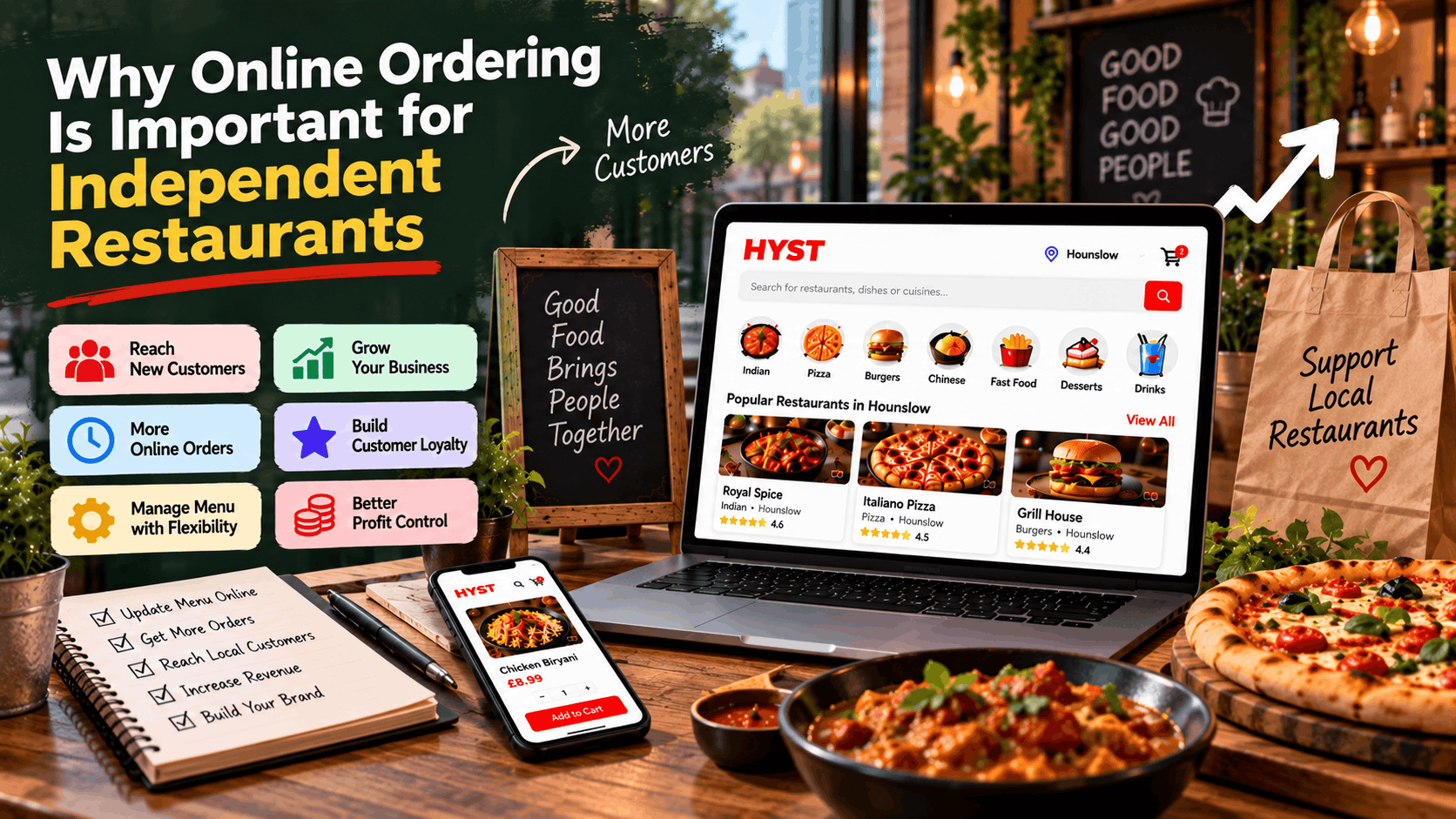
For independent restaurants, cafés and takeaways across the UK, online ordering has become an important way to reach customers beyond the physical restaurant. Platforms such as HYST give customers another way to discover local restaurants, browse menus and order food online. For independent food businesses, a well-planned digital ordering strategy can support restaurant visibility, customer convenience and long-term business growth.
Traditional restaurant marketing often depends on foot traffic, recommendations, printed menus and local advertising. These methods remain valuable, but customers increasingly search online before choosing where to eat. Someone looking for restaurants near me may compare several menus, check prices and read restaurant information before placing an order.
For independent restaurants in Hounslow, London and other UK locations, this creates an opportunity to connect with customers who might not otherwise discover the business.
1. Reach Customers Beyond Your Restaurant Location
A physical restaurant mainly serves people who visit its premises or know where it is located. Online ordering can introduce the business to customers who discover it through search engines, social media, websites and digital food marketplaces.
For example, a customer searching for Indian takeaway in Hounslow may discover a local restaurant while browsing online. Another customer may search for pizza delivery in Hounslow and compare menus before choosing a meal.
Relevant search terms include:
- Independent restaurants UK
- Online ordering for restaurants
- Online food ordering UK
- Restaurants in Hounslow
- Hounslow food delivery
- Hounslow takeaway
- Indian restaurants Hounslow
- Pizza delivery Hounslow
- Local restaurants near me
- Food delivery near me
- Order takeaway online
- Restaurant ordering system
Restaurants should incorporate relevant phrases naturally into their website, menu pages and useful blog content. The goal is to answer customers' questions rather than repeat keywords without adding value.
2. Make Your Restaurant Easier to Discover
Online visibility is important because customers cannot order from a restaurant they cannot find.
Independent restaurants should maintain accurate business information, including their address, opening hours, contact details, menu and available ordering options.
A clear website, updated restaurant listings and useful local content can help customers understand what the business offers.
For businesses in Hounslow, content about local cuisine, takeaway options, restaurant menus and food ordering can support local discovery when it is genuinely relevant to the business.
Restaurants can also explore HYST's guide to increasing direct online orders for additional ideas about improving the digital ordering journey.
3. Provide a Convenient Customer Experience
Customers often choose online ordering because it saves time and makes food selection more convenient.
They want to browse menus, compare dishes, check prices and complete an order without unnecessary steps.
A good online ordering experience should include:
- Clear menu categories
- Accurate food descriptions
- Current prices
- Good-quality food photographs
- Available customisation options
- Clear delivery or collection information
- An easy-to-use basket
- A straightforward checkout process
Restaurants should test their ordering journey on desktop computers and smartphones. A menu that is difficult to read or a checkout process that creates confusion can discourage customers from completing their order.
4. Keep Digital Menus Accurate
An online menu represents the restaurant before the customer experiences its food.
If the menu contains outdated prices, unavailable dishes or incomplete descriptions, customers may lose confidence in the business.
Restaurant owners should regularly review their digital menus and update prices, availability, descriptions, add-ons, opening hours and relevant dietary information.
HYST's restaurant ordering FAQs explain how participating restaurant partners can manage their menu items, prices and availability.
Accurate information helps customers make informed decisions and can reduce unnecessary questions for restaurant staff.
5. Support Repeat Orders and Customer Loyalty
Online ordering can help independent restaurants make the customer journey more convenient after the first purchase.
A customer who enjoys a restaurant's food may want to order again during a busy workday, a family evening or a weekend gathering.
Restaurants can encourage repeat business by maintaining consistent food quality, keeping their online menus current, providing reliable service and making ordering straightforward.
Customer retention should be considered alongside attracting new customers. A business that focuses only on acquiring first-time buyers may overlook the long-term value of customers who return regularly.
6. Understand the Financial Benefits and Costs
Online ordering can create new sales opportunities, but additional orders do not automatically guarantee higher profits.
Restaurant owners should consider food costs, packaging, staff time, payment processing, delivery expenses, marketing and applicable platform charges.
HYST promotes a zero-commission model for participating restaurant partners, subject to the specific commercial terms in each restaurant's agreement. Restaurants can review the HYST restaurant partner programme when assessing whether the model fits their business.
The important calculation is not simply how many orders arrive. It is how much contribution remains after the costs associated with fulfilling those orders.
7. Give Independent Restaurants Greater Menu Flexibility
Independent restaurants frequently need to change their menus.
They may introduce seasonal dishes, update prices, remove sold-out items or change opening hours during holidays.
Digital menu management can make these updates easier to communicate to customers.
Restaurant owners should choose ordering tools that fit their operational needs and allow them to maintain accurate information without creating unnecessary administrative work.
For more context, read HYST's article on independent restaurants and online ordering control.
8. Improve Local SEO and Restaurant Marketing
Search engine optimisation can help restaurants become more visible when people search for relevant food businesses.
Useful local SEO practices include:
- Maintaining accurate local business information
- Creating original restaurant descriptions
- Publishing helpful local food articles
- Keeping menus accessible
- Using relevant location terms naturally
- Optimising website pages for mobile devices
- Earning relevant, trustworthy backlinks
- Improving page speed and usability
For example, an Indian restaurant in Hounslow can create helpful content about its cuisine, menu and service area. A local café can publish information about its breakfast menu or collection options.
Avoid publishing multiple pages that simply repeat the same keywords. Each page should serve a clear purpose and help the reader.
9. Use Online Ordering Alongside Social Media
Social media can introduce restaurants to new audiences and remind existing customers about the business.
Restaurants can share food photography, new menu items, preparation videos, seasonal dishes and useful updates. Their profiles should make it easy for interested customers to find the menu and ordering information.
A consistent approach across the website, social media and online ordering pages helps customers recognise the business and understand how to place an order.
10. Measure Results and Improve Gradually
Restaurants should track the performance indicators that help them make decisions.
Depending on the available tools, these may include website visits, menu views, ordering-link clicks, completed orders, average order value and repeat purchases.
If website traffic increases but completed orders do not, the restaurant may need to review its menu presentation, pricing information, mobile experience or checkout process.
Small, evidence-based improvements are often more useful than changing the entire digital strategy at once.
Conclusion
Online ordering is important for independent restaurants because it can help customers discover the business, explore its menu and place orders more conveniently.
For restaurants in Hounslow and across the UK, the opportunity is to combine traditional hospitality with an accurate digital presence, useful local SEO, convenient ordering and consistent customer service.
The best approach is to focus on the complete customer journey: discovery, menu browsing, ordering, fulfilment and repeat business.
Restaurants should assess each ordering channel based on customer experience, operational needs and actual costs. Before joining any platform, they should also review the applicable HYST terms and conditions and their individual commercial agreement.
Online ordering is not a guaranteed route to success, but when implemented thoughtfully, it can become a valuable part of an independent restaurant's long-term growth strategy.